Our History
Assistance League®
Assistance League is part of the first wave of nonprofit organizations in the United States that empowers ordinary citizens to improve communities and transform lives through long-term volunteerism.
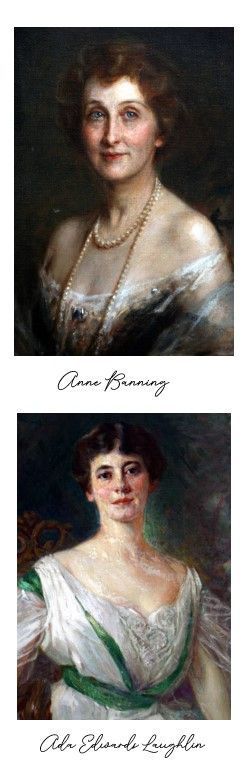
Organized as a national nonprofit in 1935, Assistance League’s roots date back to the turn of twentieth century America when founder, Anne Banning, pioneered a tradition of compassion and benevolence carried on by her modern-day counterparts in Assistance League chapters around the country.
Anne Banning and her close friend and co-founder, Ada Edwards Laughlin, married into influential, well-to-do families. Anne’s father-in-law, Phineas, is the “Father of the Port of Los Angeles.” Her husband, Hancock, was instrumental in the development of Catalina Island. Ada, a Stanford graduate, teacher and proponent of women’s basketball, married Homer Laughlin Jr., whose family is known for creating the iconic Fiesta Dinnerware that is still popular today.
A social activist at heart, Anne and a small group of prominent ladies began doing local charitable work in the mid-1890’s under the name Assistance League. Their humanitarian efforts extended beyond local boundaries to the victims of the San Francisco earthquake. To raise money for those people underserved by conventional charities, Anne used her social connections to establish the “pay to attend” fundraising model that has proven successful for nonprofit organizations. During World War I, Anne organized the Los Angeles Red Cross Chapter and served as its Director.
In 1919, Anne, Ada and their charity-minded friends formalized Assistance League of Southern California, as a precursor to the national organization. They began by providing food and clothing for local families severely impacted by the war. A few years later, they greatly expanded their efforts with a neighborhood Community House that offered programs and services, which were emulated by public and private agencies
.Inspired by a life of privilege to help people adversely affected by their circumstances, Anne and Ada created a legacy of giving back that endures today. When they retired in 1948, there were 10 local chapters throughout Southern California.
Operation School Bell®
Operation School Bell was originated by Ruth Ann Montgomery, charter member of the Bakersfield chapter, with the purpose of clothing children who might otherwise be unable to attend school because they lacked the most basic school attire.
Ruth Ann Montgomery had been a junior high school teacher in North Hollywood in the early 1950’s. The San Fernando Valley was a rural area with farmland and citrus groves. North Junior High students had parents who were movie stars, as well as parents who were migrant farm workers. The contrast between their appearances highlighted the scarcity of resources available to the migrant children. The young teacher asked the wealthy parents for their children’s castoffs and began keeping a closet of used clothes in her classroom. “But children could be mean. They could see their clothes on other children and pointed it out.” She dreamed of a program where good used clothes could be passed onto needy children without anyone knowing.
 In 1954, Ruth Ann Montgomery and her family moved to Bakersfield. The mother of three young children, she revived her idea of the “Clothes Closet” and clothing needy schoolchildren. “People said, ‘Good luck. You’re never going to find women who would want to collect clothes and wash them,” Montgomery recalled. But she did. Twenty-three women began collecting, sorting and laundering used clothes, using one woman’s garage as the collection point. In 1956, they named themselves Volunteer Service Guild and their program was enthusiastically received in the community. Helping with public relations was charter member Winnie Davis’ husband, Tom. As a World War II veteran, he was accustomed to the military’s use of the word “operation.” This campaign would be called Operation School Bell. They were aware that the children were stigmatized by wearing used clothing, so they began to hold luncheons where the price of admission was a new article of clothing.
By spring 1957, Ruth Ann Montgomery, who had studied other nonprofit organizations to merge with, chose National Assistance League. In April, members of the Volunteer Service Guild were guests at Assistance League’s headquarters in Hollywood. On May 28, 1958, Mrs. Theodore Fouch, President, went to Bakersfield to install the Volunteer Service Guild as the 23rd chapter, Assistance League of Bakersfield. While she was there, Mabel Fouch, a former Bakersfield resident, heard that the garage being used was no longer available and personally loaned money for the purchase of an old church where clothing could be assembled and distributed.
Ruth Ann Montgomery and the Bakersfield chapter wrote detailed reports on the policies and procedures of Operation School Bell that were shared with other Assistance League chapters. A workshop on Operation School Bell was held at the National Convention in Denver in 1968. Since then, chapters have continued to adopt this program in their communities. Many chapter auxiliaries, including Assisteens ® , also participate by providing hygiene kits or backpacks, school supplies and books.
The National Board voted to make Operation School Bell a national program in July 1997, as a direct result of a survey and the suggestions of the membership. The name and logo were trademarked.
The National Convention in Seattle in 1999 featured the official launch of the national campaign for Operation School Bell. Hunter Barth, an advertising and public relations firm in Costa Mesa, California, donated professional services in planning strategic marketing objectives and received the inaugural Ruth Ann Montgomery Award for Outstanding Service. One aspect of the national campaign included producing an informational video and two public service announcements.
Many organizations, foundations and individuals support Assistance League and Operation School Bell by providing significant financial, in-kind, hands-on and spiritual support. The direct, powerful and positive effect these contributions have on the Operation School Bell program is often recognized with presentation of the National Operation School Bell Award.
Operation School Bell won the Award of Excellence in the 2003 Associations Advance America Awards program. Retail catalog Lands’ End made a contribution in 2003, and in their holiday card to customers, mentioned Operation School Bell and “the mission to provide school clothes, shoes and literacy programs to underprivileged students, with the goal of helping kids feel not only better about themselves—but about going to and staying in school.”
At the 2008 National Conference, Ruth Ann Montgomery was honored as the person who began Clothes Closet, now Operation School Bell, without a penny and opened her closet and heart to children, resulting in the thousands of children who are benefiting from the belief that one person can make a difference.
Sierra Foothills